Choosing a digital wellness platform means looking beyond features. Here’s what HR and benefits leaders should consider to find a solution employees will use and one that delivers measurable, verifiable results.
Summary – TL;DR
When evaluating a digital wellness platform, look for six things: a fit with your workforce, simple access, personalized behavior change support, an engaging user experience, support beyond the screen (such as clinical oversight, coaching, and community), and measurement you can trust, including outcomes and ROI built with your input.
Digital wellness platforms give employers new ways to connect employees with health resources, education, and support. But with so many options, deciding which one is right for your workforce can be challenging.
It has also become harder to take vendor claims at face value. Many benefits leaders have seen impressive ROI projections that didn’t hold up once they were measured against their own data. As a result, the question is no longer just “what does this platform offer?” but “how will we know it’s working, and who decides?”
A platform may offer an impressive list of features, but that doesn’t guarantee employee participation or meaningful outcomes. Complicated enrollment, one-size-fits-all content, and limited support can all get in the way.
For HR and benefits leaders, the evaluation should go beyond what a platform can do. It should consider how well the solution fits your workforce, how easily employees can access it, whether the experience is personalized and keeps them engaged, whether it offers the support needed to sustain progress, and whether the vendor will measure results with you instead of simply reporting them to you.
At a glance, here’s what to look for in a digital wellness platform:
- Workforce fit: Look for a tailored rollout and multichannel communications. Ask: How do you support implementation and employee communications?
- Access: Look for easy enrollment, mobile and desktop access, and technical support. Ask: How many steps does enrollment take?
- Personalized behavior change: Look for content and support that adapt over time. Ask: What data drives personalization?
- Engaging experience: Look for a compelling user experience that keeps participants coming back and shows progress. Ask: What does engagement look like after the first month?
- Human and clinical support: Look for clinical oversight and experts, coaches, and a peer community. Ask: What support is available after enrollment?
- Credible measurement: Look for transparent methods, agreed-upon metrics, and ROI you can validate. Ask: How will we define and measure success together?
1. What does it mean for a platform to fit your workforce?
Before comparing features, ask who you are trying to reach. Your workforce isn’t a single audience. Employees may work remotely, sit at a desk, or work shifts without regular access to company email. They may differ in technology access, health priorities, communication preferences, and familiarity with digital wellness tools.
These differences matter for both platform selection and rollout. A desk-based workforce might respond well to an email campaign with a direct enrollment link. A workforce with frontline or shift-based employees might benefit more from an in-person kickoff, a live demonstration, or QR codes in common areas.
Look for a vendor that can tailor implementation and employee communications to your organization, rather than relying on a one-size-fits-all launch.
Questions to ask vendors: How do you support program rollout? Can you provide customized marketing materials, enrollment communications, and implementation guidance? Can you help reach employees through multiple channels?
2. Why do simple access and an intuitive experience matter?
Even employees who are interested in a wellness benefit may not follow through if getting started feels complicated. Look for a platform that makes it easy to understand enrollment, create an account, and find resources. Consider whether employees can use it on both mobile and desktop, whether the interface is intuitive, and whether technical support is available.
Flexibility matters, too. Employees should be able to engage around their schedules rather than work around rigid participation requirements.
Questions to ask vendors: During a demo, walk through the experience as an employee. How many steps does enrollment require? Can you easily find lessons, resources, and support? What happens when someone needs help?
3. How important is personalized behavior change support?
A platform that delivers the same information to everyone may struggle to keep employees engaged. People have different health histories, goals, motivations, and starting points. Look for solutions that adapt the participant experience based on individual need through a personalized experience, content, and clinical support.
For weight management in particular, the approach matters. Programs built on behavior change help participants build lasting skills and habits instead of relying on short-term tactics.
Wondr Health, for example, is built on a behavior-change foundation. It uses ongoing assessments to personalize the solution through tailored messaging, content recommendations, and condition-specific clinical care paths.
Personalization should extend beyond enrollment. As employees build new skills and their needs change, the platform should offer relevant ways to keep learning and building on their progress.
Questions to ask vendors: What information informs your personalization strategy? Is the program built on behavior change? Does the platform adapt content and recommendations over time, or does every participant follow the same experience?
4. What makes a digital wellness experience engaging?
Getting employees to enroll is one challenge. Keeping them involved is another. An engaging experience is one people choose to come back to, not one they feel obligated to complete, and it often separates a platform with strong sign-ups from one with lasting participation.
Engagement doesn’t start at enrollment, and it doesn’t end when the first results show up. Look for a platform that supports the whole journey:
- Awareness and consideration. Employees learn about the benefit through channels they trust, such as benefits meetings and employer-approved communications. The timing and relevance of those messages often determine whether someone takes a closer look.
- A personalized start. An initial health assessment helps the program understand each person’s goals, health profile, risks, and preferences from day one.
- An experience that adapts to the participant. Not everyone is on the same path. Some people need behavioral support only, some are considering medication, and others already use it and need clinical support. Look for access to coaching, skill-building content, nutrition support, community-based coaching, and clinical services within a single experience.
- Visible milestones. Participants stay motivated when they can see progress, whether that’s weight loss, improved metabolic health, or reduced risk factors.
- Meaningful rewards. Recognition and incentives give people a reason to keep going, especially when the early excitement fades. The most effective rewards are tied to real progress and healthy habits, not just logging in, and they feel attainable at every stage of the journey.
- Support for maintenance. Many programs struggle most after the early wins. Ongoing engagement and personalized support help improvements last.
The best programs also manage the complexity behind the scenes. Communications, eligibility, clinical services, and monitoring should run smoothly in the background, so the experience feels simple for participants and doesn’t create an operational burden for the employer or plan sponsor.
Engagement should also be measurable. Ask how the vendor defines it, and whether it reflects one-time activity or participation over time.
Questions to ask vendors:
- What does the participant journey look like after the first 30 days, and through maintenance?
- How does the experience adapt for people with different needs, such as behavioral support only versus medication support?
- What rewards or incentives are available, and how do they encourage lasting habits rather than one-time activity?
- How do you define and report engagement?
- Can I try the participant experience myself during a demo?
- What do you do when participants disengage?
- Which operational tasks, like eligibility, prior authorization, and communications, do you manage, and which fall to my team?
5. Do employees need clinical oversight, coaching, and support beyond the screen?
Yes. Digital access is valuable, but employees shouldn’t have to navigate their health journeys alone. Look for platforms that combine digital resources with human connection, such as qualified coaches, expert instruction, peer communities, clinical oversight, and added guidance when challenges arise. These features make a digital experience feel more supportive and give participants more reasons to stay involved.
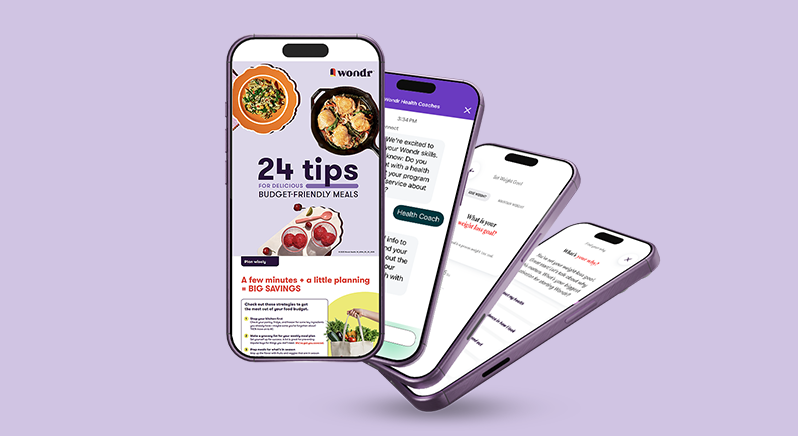
Wondr Health combines digital lessons and tracking tools with health coaching and an online participant community. It also offers different levels of support based on individual needs, from behavioral care to personalized clinical care, including medication support when clinically appropriate.
Questions to ask vendors: What happens after an employee enrolls? Is coaching available throughout the program? Is there clinical oversight, and how do participants move into clinical care when needed? Can participants ask questions, receive feedback, and connect with others?
6. How can you tell whether a platform’s ROI is credible?
Features and enrollment numbers tell only part of the story. Employers also need to understand whether the solution is delivering, and with ROI claims under more scrutiny than ever, how that conclusion was reached matters as much as the number itself.
A useful way to evaluate any platform is to follow the chain of evidence from first sign-up to final return. Aon recently presented its “Measuring ROI in Complex Ecosystems” framework. Each link should be measured separately, because a strong ROI figure is only as believable as the links beneath it:
- Participation: Are people signing up? (Enrollment and reach)
- Engagement: Are participants using the solution? (Usage and adherence)
- Behavior change: Are they changing what the program wants them to change?
- Clinical outcomes: Are clinical measures improving? (Health status)
- Utilization: Are avoidable healthcare services decreasing? (Healthcare use)
- Financial outcomes: Is healthcare cost actually changing? (Claims and cost)
- Incremental impact: Did the program cause the change, or would it have happened anyway? (Causal effect)
- ROI: Did the value exceed the cost? (Value relative to investment)
Enrollment and activation show whether employees are getting started, and ongoing participation offers insight into engagement. Clinical and health outcomes show whether the program is making a meaningful difference, while financial results and ROI show whether the investment is paying off.
Then look at how a vendor handles the measurement itself. Credible ROI usually has a few things in common:
- Metrics are defined up front. You and the vendor agree on what success means before launch, not after results come in.
- Methods are transparent. The vendor can explain the baseline, the comparison, the timeframe, and the assumptions behind the figures.
- Projected and realized results are labeled clearly. Early estimates are useful, but they should be distinguished from outcomes validated over time.
- Measurement is a shared process. Results are reviewed regularly with your team, using your data where possible, and the approach is refined together.
In a market where every vendor can produce an impressive multiple, the number itself is less meaningful. The new standard is whether an employer can see the methodology, test the assumptions, validate the results against its own claims, and agree up front on what success will mean. The winning vendor won’t ask employers to trust its ROI. It will help them prove it.
Wondr Health approaches measurement with that standard in mind, as a partnership with the employer. Success measures are defined together, results are shared transparently, and weight, cardiometabolic health, risk reduction, and sustained behavior change are tracked alongside financial outcomes. In a 12-month pilot with a U.S. technology client, participants in the behavioral-only care path saw average weight loss of 9%, and those in the integrated behavioral and clinical path saw up to 16% weight loss. This translated to a combined first-year ROI of Wondr Health delivered a combined 2.7x and $900,000 reduction in total annual medical claims costs.
Questions to ask vendors:
- How will we define success together before launch?
- Can you walk us through your methodology, including the baseline, comparison group, timeframe, and assumptions behind your ROI figure?
- Which assumptions have the biggest effect on the result, and can we adjust them to reflect our population?
- Can results be validated against our own claims data?
- How do you show that the program caused the results, rather than other factors?
- Can I track enrollment, engagement, health outcomes, and ROI separately?
- How do you distinguish projected from realized results, and when do projections get replaced with actuals?
- Can you show an example of your reporting?
- What safeguards protect participant information, and what, if anything, is shared with us as the employer?
Choose a platform that works for your people, and proves it with you
The right digital wellness platform isn’t necessarily the one with the longest feature list or the biggest ROI claim. It’s the one that aligns with the needs of your population, makes meaningful participation realistic, keeps employees engaged, and is willing to measure results alongside you.
As you evaluate partners, look beyond the initial demo. Consider how employees will discover the benefit, how easily they’ll get started, whether they’ll want to keep coming back, and whether the vendor will help you create and verify value over time.
At Wondr Health, we believe effective employee wellness support starts with understanding the people it’s designed to serve, and that results are most credible when employers and vendors build and measure them together. Our digital behavior change programs combine personalized content, expert guidance, coaching, and community support, with implementation resources and transparent reporting to help employers engage their workforce and measure what matters.
For more information, get in touch with us today.
Frequently asked questions
What is a digital wellness platform?
A digital wellness platform is an online or mobile solution that connects employees with health resources, education, and support. Depending on the program, it may include lessons, tracking tools, coaching, and community features.
How do you evaluate a digital wellness platform?
Evaluate workforce fit, ease of access, personalized behavior change support, user experience, support beyond the screen, and how results are measured. A hands-on demo from an employee’s point of view is one of the most useful steps.
What makes a digital wellness platform engaging?
Engaging platforms fit into busy schedules, show participants their progress, and offer timely, relevant prompts and varied content. Ask vendors to report engagement over time, not just at enrollment.
How can employers evaluate a vendor’s ROI claims?
Ask how success is defined, what baseline and comparison were used, and whether results are projected or realized. Look for vendors that agree on metrics with you up front and review results with you regularly.
What features matter most in an employee wellness platform?
Features matter less than whether employees will actually use them. Prioritize simple enrollment, mobile and desktop access, personalized content, an engaging experience, access to coaches or clinical support, and transparent reporting.
How do you increase employee engagement with a wellness platform?
Tailor rollout to how your employees work, use multiple communication channels, make enrollment simple, and choose a platform with a personalized, engaging experience and human support.
How do you measure the success of a digital wellness platform?
Track enrollment and activation, ongoing participation, health outcomes, and ROI as separate measures. Ask vendors to explain how each is measured and to show example reports.